

June 2026—Pearl Lam Projects is pleased to announce its appointment as the exclusive global representative gallery of artist Zhu Jinshi, one of the most influential pioneers of Chinese abstract art and installation art. Having proudly represented Zhu Jinshi for many years, the gallery looks forward to this new chapter as a significant milestone in advancing his international presence and deepening engagement with his work among institutions, curators, and collectors worldwide.
Born in 1954, Zhu Jinshi is a Chinese-born German artist whose groundbreaking practice has played a pivotal role in the development of contemporary Chinese abstraction. Beginning his exploration of abstract painting in the early 1980s, Zhu moved to Berlin in 1986, where he expanded his practice to encompass performance, installation, and conceptual art. Since 1994, he has maintained an active dialogue between the East and West through sustained engagement between Berlin and Beijing, participating in major exhibitions across Europe, Asia, and beyond.
Internationally acclaimed for his innovative use of materials, most notably rice paper and bamboo, Zhu’s installations challenge conventional notions of space, materiality, and perception. Over more than four decades, abstract painting and installation have developed in parallel within his practice—sometimes complementary, sometimes deliberately confrontational. While his installation works stand independently, they have continually informed and transformed his approach to painting, yielding a distinctive visual language that bridges medium, culture, and history.
Viewed together, Zhu’s paintings and installations reveal the full breadth of his artistic vision. His works embody a remarkable vitality and openness that transcend artistic categories, geographical boundaries, and distinctions between Eastern and Western identities. Through a deeply personal yet globally resonant practice, Zhu has created an evolving artistic narrative that reflects the complexities of contemporary culture while remaining rooted in a lifelong pursuit of material and spiritual exploration.
Pearl Lam, Founder of Pearl Lam Projects, says, “We are delighted to continue our longstanding relationship with Zhu Jinshi and to now serve as his exclusive global representative gallery. Zhu is one of the most important voices in the history of Chinese contemporary art. For over four decades, he has consistently pushed the boundaries of abstraction and installation, creating works that are both intellectually rigorous and profoundly moving. His ability to transcend cultural and geographical boundaries while maintaining a deeply personal artistic language has made his practice increasingly relevant on the international stage. We look forward to further strengthening his global presence and introducing his extraordinary body of work to new audiences, collectors, and institutions worldwide.”
Through this exclusive global representation, Pearl Lam Projects will continue to work closely with Zhu Jinshi on major exhibitions, institutional collaborations, publications, and international initiatives that further solidify his position as a leading figure in contemporary art.
About Zhu Jinshi
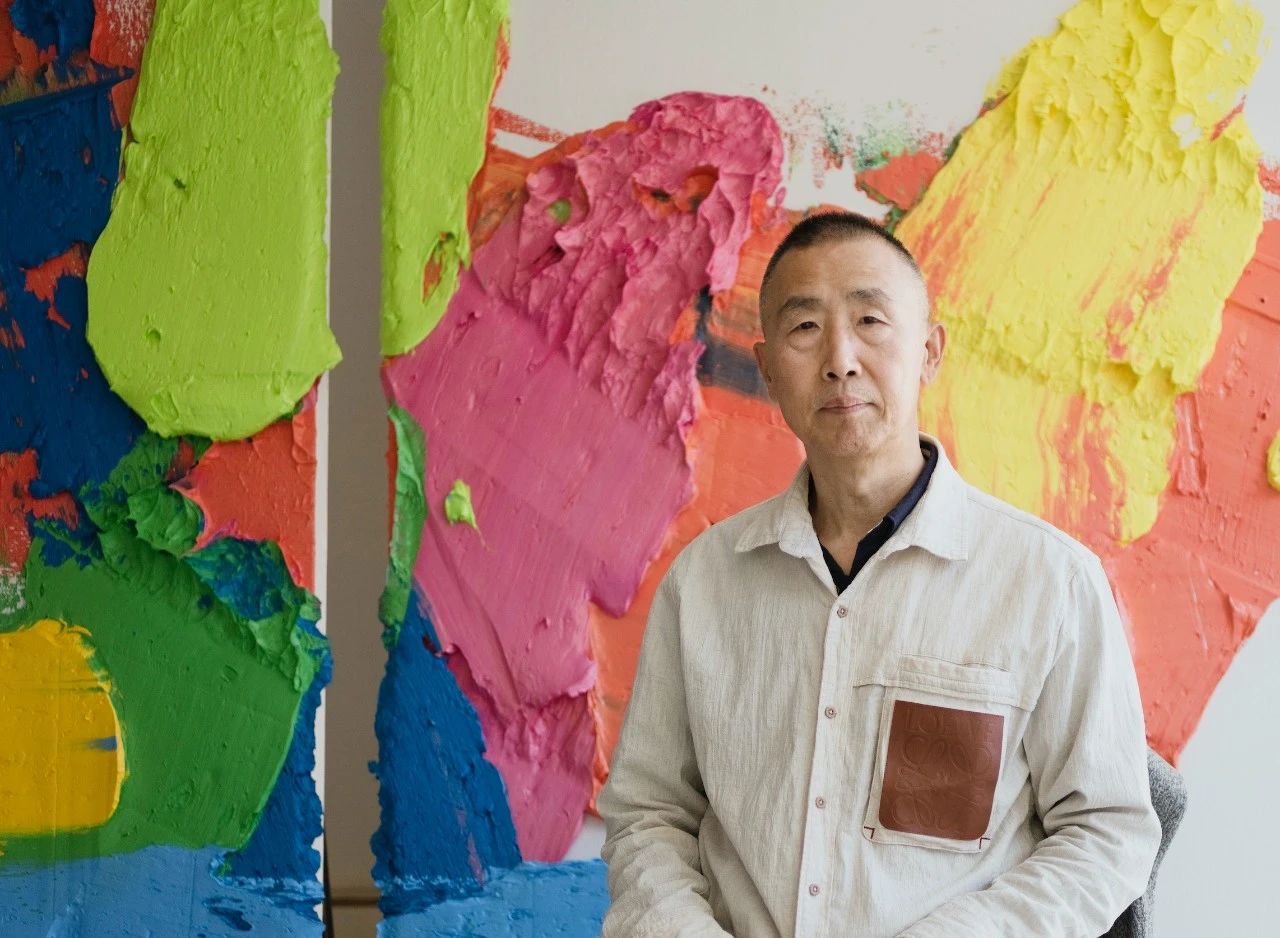
Zhu Jinshi’s paintings were first influenced by China’s post-Cultural Revolution reawakening to the 20th century modernist movement. Three of his works were exhibited in China’s first avant-garde exhibition, the Stars Group Exhibition, in 1979. As one of the first Chinese artists to create abstract art, Zhu initially experimented with random brushstrokes and limited colour to create abstract paintings. He gradually developed his unique “thick painting” (impasto) style that he still uses today, which is usually applied in abstract compositions with heavy colour and thick paint.
In contrast to the Western mainstream post-1990s compositionist, neo-geometric abstract painting, he compared the differences between art techniques and philosophies at a macro level during his roundtrips between Beijing and Berlin over the past twenty years. Although the strong styles of Gerhard Richter, Julian Schnabel, Per Kirkeby, and Kazuo Shiraga in the 1980s impressed him, when he returned to painting after 2000, Zhu identified more with the direction of newer artists such as Albert Oehlen and Cecily Brown, focusing on his own experience and disregarding the idea of traditional abstraction.
Art critic and professor Gao Minglu says, “Unlike the formal rhythm of modern abstraction, which relies mainly on the charm of self-expressive brushstrokes, the expressive power of Zhu Jinshi’s ‘thick paintings’ comes more from the stubbornness and fluidity of the objects (paint) themselves.” He uses strong and tense techniques, employing palettes, wall trowels, wooden shovels, and fifteen-centimetre brushes to apply heavy colours of paint onto the canvas. The shaping of two-dimensional space and the spirituality emphasised in the history of abstract painting are not his interests; instead, his works are sculptural and three-dimensional with the effect of his materials. The gaps, fractures, white space, thickness, and paint form a self-contained visual system. This sense of monumental objects makes Zhu’s paintings not only an art of space, but also an art of concept.
In contrast to his prior painting practices, Zhu’s exploration of conceptual art, performance, and installation began in the late 1980s when he moved to Germany. He took the initiative to use his formalist experience to focus also on social issues. In 1988, Zhu developed the “FANG ZHEN” art project, in which he set up a cubic metre of linen in Berlin, Germany and a cubic metre of rice paper in Beijing, connecting two cities and cultures through four sections in this project: display, visiting, participation, and barriers. In 1989, he created the work Exile, a homemade raft with many bottles of Chinese export soy sauce tied to it, depicting the pursuit of his cultural identity. The relative lack of public exhibition space in China in the 1990s prompted a group of artists who had emigrated overseas to open up their private apartments as experimental exhibition spaces. Zhu’s residence in Ganjiakou, Beijing became an active gathering place for artists at the time.
What has made Zhu Jinshi internationally known is his surprising use of materials such as rice paper and bamboo in his installations. In works such as Impermanence (1996), Boat (2012–2015), and Tao of Xuan Paper (1997), the physical qualities and cultural attributes of paper itself are dissolved; instead, the soft papers are given an architectural volume, lightly stacked to become complex and tough. In the open space, the art shifts from private to public, and the works extend together with the space to become a special structural landscape. Zhu Jinshi’s large-scale rice paper installation Rice Paper Pagoda (2024) was exhibited at the 60th Venice International Art Biennale’s China Pavilion exhibition project, Atlas: Harmony in Diversity, from April to November 2024.
As one of the earliest practitioners of abstract and installation art in China, Zhu Jinshi’s creations have shown great vitality and extensibility, and these qualities continue to exist in his current creations. His works are not limited by artistic mediums or times, but rather transcend geography and differences in Eastern and Western identity, taking a macro perspective and sketching a personal history of artistic evolution in the context of contemporary global culture.