

Contemporary Istanbul 2026
Contemporary Istanbul 2026
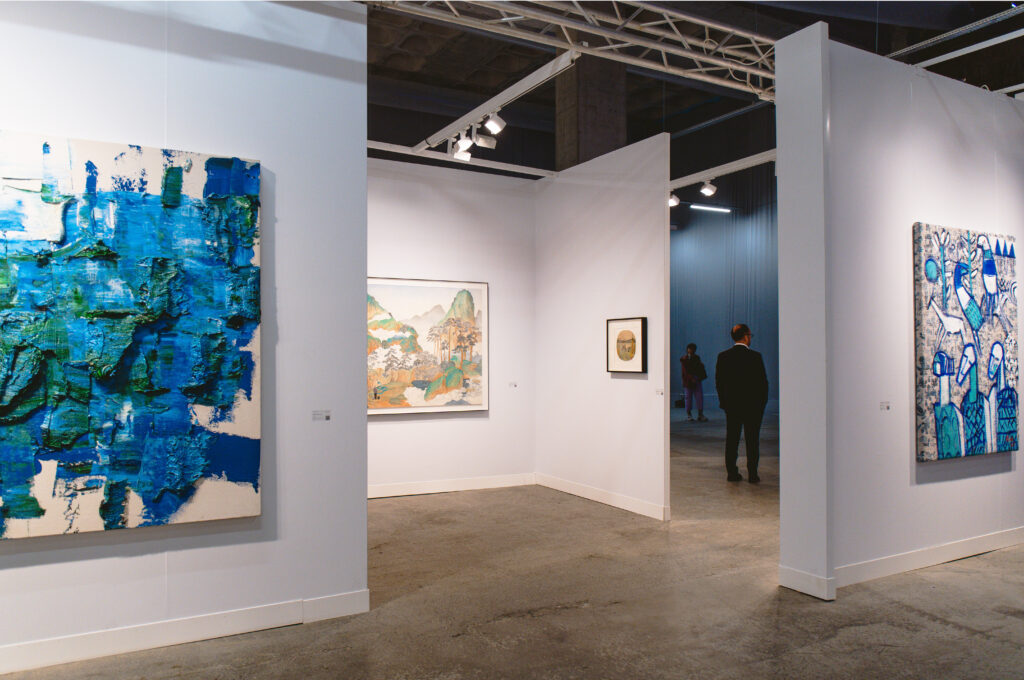
Stand B104
23—27 September, 2026
Tersane Istanbul, Camiikebir, Taşkızak Tersanesi Caddesi No:2, 34440 Beyoğlu/İstanbul, Turkey
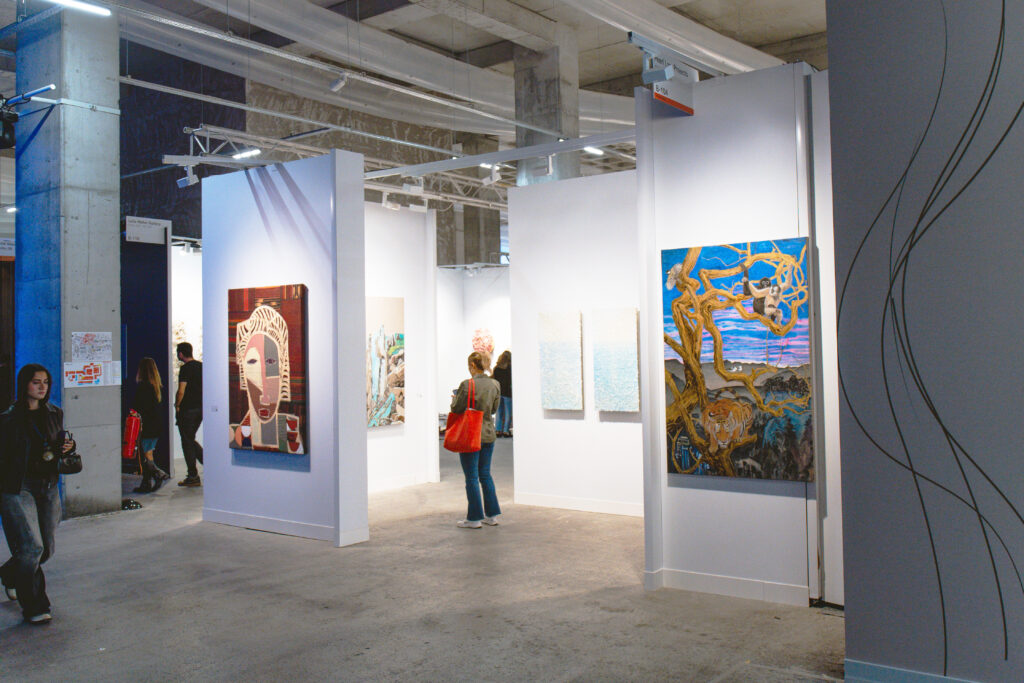
Istanbul—Pearl Lam Projects makes its debut at the 21st edition of Contemporary Istanbul, presenting seven artists from China, Japan, Nigeria, and the United Kingdom. Artists on view include Alimi Adewale (b. 1974, Nigeria), Mr Doodle (b. 1994, UK), Chisato Matsumoto (b. 1994, Japan), Qiu Anxiong (b. 1972, China), Su Xiaobai (b. 1949, China), Arashi Tanaka (b. 2000, Japan), and Zhu Jinshi (b. 1954, China).
Spanning painting, object, textile, and photographic practices, the presentation brings together artists across generations and geographies, offering fresh perspectives on form, medium, and meaning. The lineup reflects the gallery’s commitment to cross-cultural exchange, as Istanbul is a city whose rich history as a meeting point between the East and West closely resonates with the gallery’s own ethos.
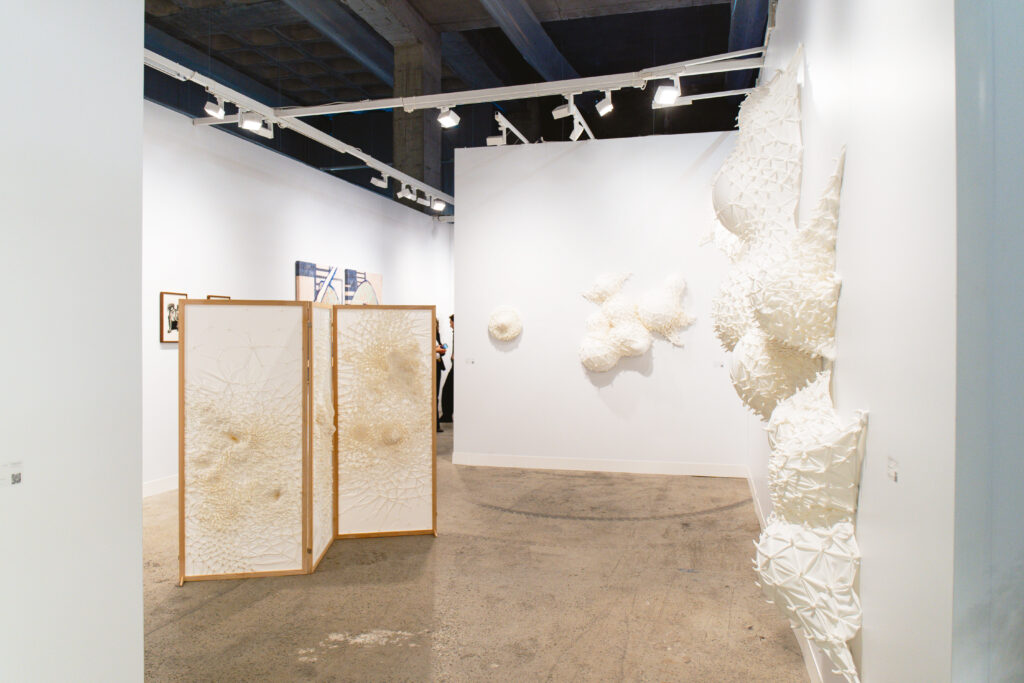
Among the exhibiting artists are two pioneers of Chinese abstraction. Zhu Jinshi is known for thickly impastoed “thick paintings” built up with palette knives and trowels until colour itself becomes sculptural; he is presenting Eastern Tiles 1, 2, a coral-and-green diptych, and Mediterranean Sea, a triptych of layered blues and greens evoking shifting light on water. Su Xiaobai has worked in lacquer since 2003, building up to twenty layers. The layers are scored, abraded, and veiled in translucent lacquer mixed with pigment and powdered metal onto linen folded over a wooden support like a cushion, resulting in a glowing, glazed skin closer to ceramic or jade than to paint. His Crackle-3 takes its title from the fine web of fractures across its surface. Also from China, Qiu Anxiong draws on classical Chinese ink painting and philosophy to articulate what he calls “modernity in flux”. In New Classic of Mountains and Seas—Watering Horses at a Limpid Stream, painted in the green-and-blue landscape style of the Tang and Song dynasties, an octopus-like aircraft drawn from the Classic of Mountains and Seas floats above two horses at a quiet stream with the hybrid figure symbolising the unchecked expansion of modern civilisation.
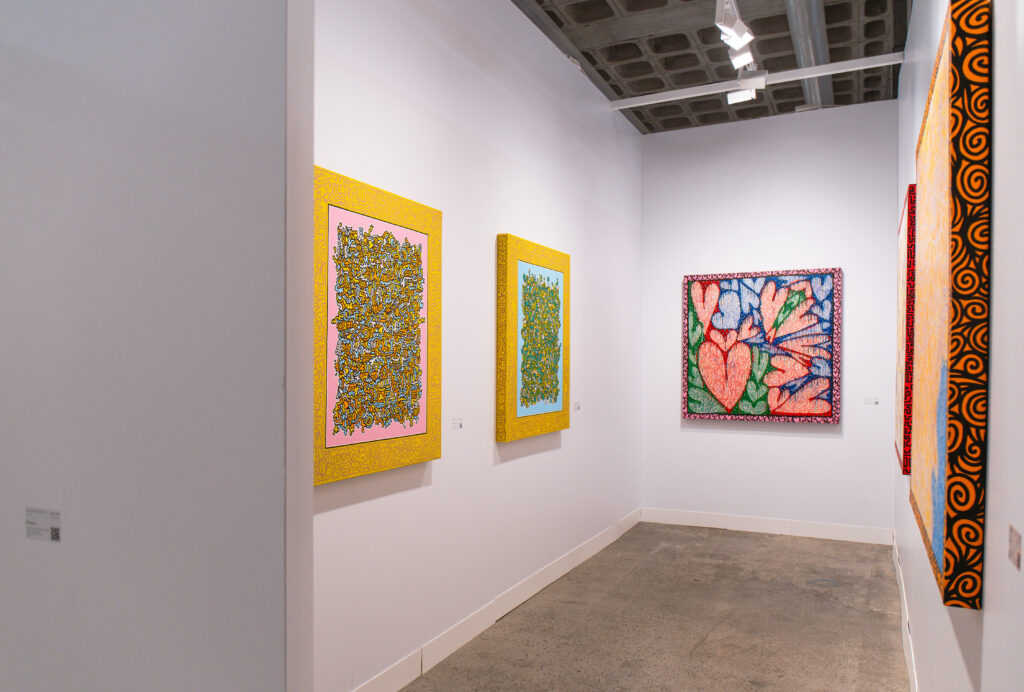
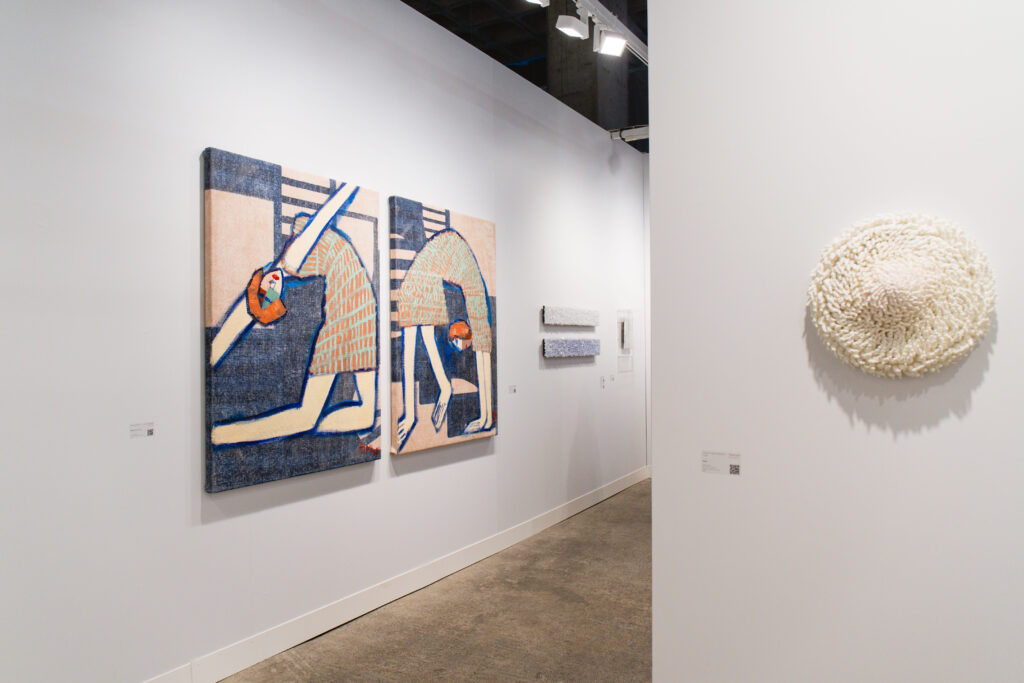
Alongside them, Alimi Adewale works at the intersection of ancestral African symbolism and contemporary iconography, painting directly onto kilim rugs whose woven patterns become active participants in each composition. Ancestral Gaze III transforms African mask traditions through fragmented planes and geometric abstraction, while Spatial Reverie III translates the rhythm of African dancers into dynamic, abstracted choreography. Mr Doodle began consuming the Earth’s surface with doodles a little time after he was born in 1994, covering his parents’ furniture and, eventually, his whole bedroom, before moving on to the walls of local fast-food restaurants and schools. During his career, he has constructed a whole new visual phenomenon: his DoodleLand, where dense clusters of characters, objects, and patterns grow and multiply relentlessly across canvas, furniture, and everyday surfaces alike.
Rounding out the presentation are two artists from Japan. Arashi Tanaka joins as the newest addition to the roster. Blending photography, sculpture, and organic chemistry, Tanaka submerges his own photographic portraits and landscapes in a solution where sound waves, drawn from a subject’s heartbeat or from ambient recordings, guide the growth of crystals across the image over several days, into tangible, topographic forms. In his Portrait series, crystalline growth follows the rhythm of a human pulse, while in his Seascape series, it is shaped by seawater-infused solutions and submerged coastal recordings. Chisato Matsumoto continues her exploration of shibori, the traditional Japanese method of tie-dyeing, though it is not the dyeing itself that draws her but the tiny cloth forms, or “shibori grains”, created by binding cloth with thread. Matsumoto binds each individual unit by hand, and through the repetition and accumulation of these small gestures, the work expands from microscopic units into large-scale, three-dimensional forms. The trace of the hand remains central to this process: as singular elements gather into a larger whole, her work reflects on the relationship between the individual and the crowd.
Pearl Lam Projects will also be bringing a special site-specific installation by Chisato Matsumoto, transported all the way from Hiroshima, Japan, to the historic Tersane Istanbul. The work is presented as part of the Contemporary Istanbul Foundation’s Public Art Program and will be on view to all fair visitors. Titled Sail of Light, the work extends hand-bound shibori fabric across the space by means of ropes and pulleys, forming organic structures reminiscent of sails or wings. Their accumulation evokes the continuous movement of ships and people gathering at the harbour before setting out once again across the world. At the centre of the installation is a luminous form recalling the beacons that have long guided ships and travellers into port, fostering encounters and cultural exchange. Conceived specifically for Tersane Istanbul, the historic shipyard district where ships were built and sails were raised, the installation, measuring approximately H1000 x W1500 x D1000 cm, draws a dialogue between Japanese craftsmanship and Istanbul’s centuries-long history as a crossroads of people, ships, and cultures. As visitors walk beneath and through the suspended forms, they are invited to experience themselves as part of a larger, continuous flow that has connected people across time.
“The artists we are showing span four countries and three generations, each rooted in a distinct tradition—such as classical Chinese ink and lacquer, Nigerian textile and symbolism, Japanese shibori and crystallisation—and Istanbul, a city built on centuries of exchange between the East and West, is exactly the kind of place where those traditions can speak to each other.”
—Pearl Lam, Founder